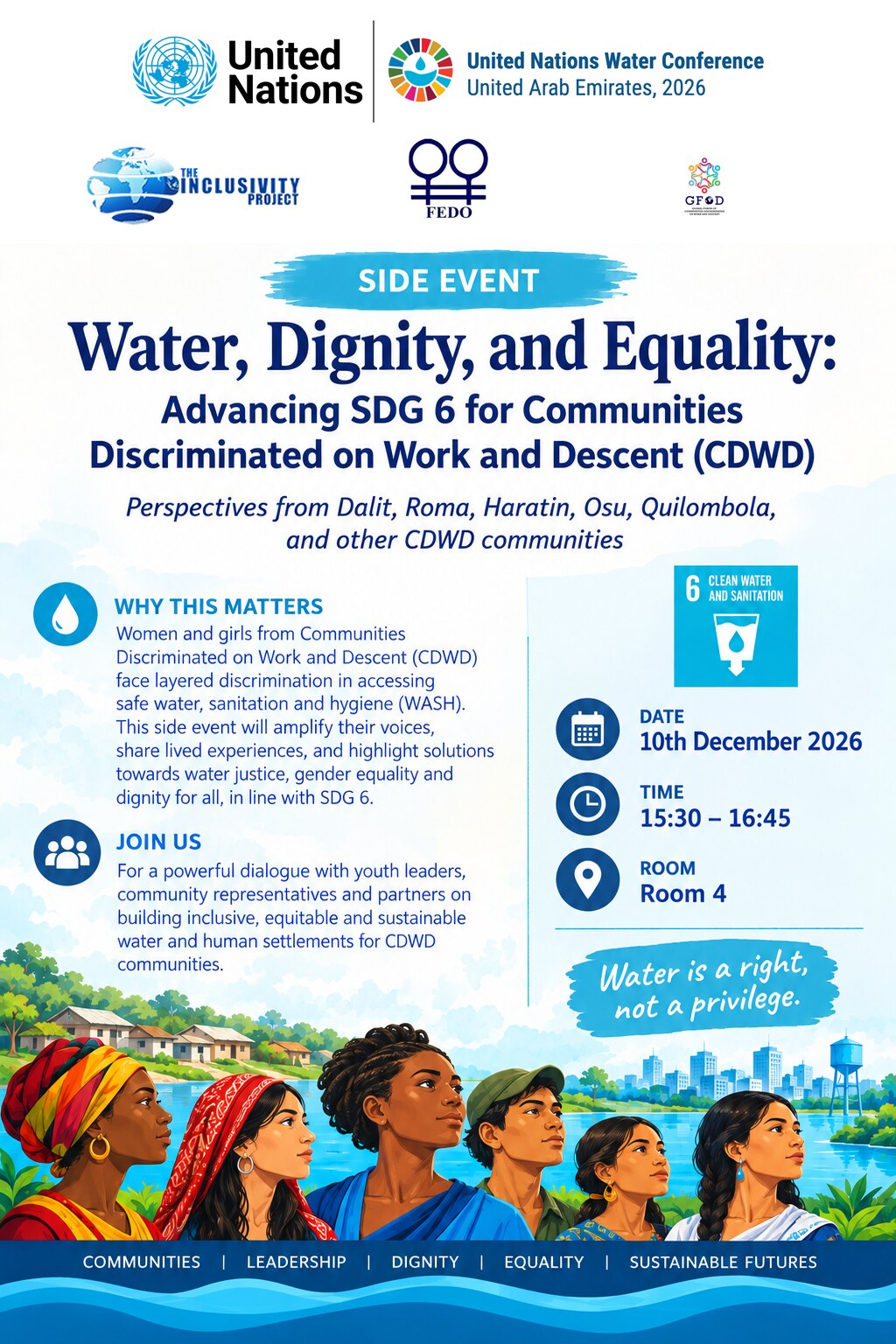
Water justice for all: communities discriminated on work and descent at the 2026 UN Water Conference
At the 2026 United Nations Water Conference in the United Arab Emirates, communities discriminated on work and descent (CDWD) will ask Member States to recognise the exclusion that keeps them from safe water and sanitation. They go with six policy briefs and a focus on women, water and dignity, prepared by the Global Forum of Communities Discriminated on Work and Descent (GFoD).
Why communities must raise this themselves
More than 330 million people around the world experience discrimination based on work and descent: Dalits, Roma, Quilombola, Haratine, Osu and other communities whose place in society is set by the caste, descent or inherited occupation they are born into. That status decides who may use a shared water source, where water points are built, who is expected to clean sewers and septic tanks, who sits on water committees, and whose settlements public investment reaches.
More pipes alone will not close these gaps. National averages hide them, and most water and sanitation data does not record caste or descent at all, so the communities most excluded are also the least visible. When governments report progress on SDG 6, clean water and sanitation for all, these communities can be missing from both the count and the plans.
That is why communities need to raise it themselves, in their own words. Their testimony and the evidence they gather show forms of exclusion that official data misses. The briefs ask that communities take part in water decisions from the very start, as rights-holders, knowledge-holders and decision-makers. Women and girls carry the heaviest share: long walks to collect water, risks to their safety, unpaid care work, and too little safe sanitation and menstrual hygiene.
What the policy briefs ask Member States to do
- Water for People: recognise that caste and descent still decide access to water and sanitation, and put excluded settlements first in water and sanitation investment.
- Water for Prosperity: end hazardous sanitation work, and give sanitation workers safety, fair pay, social protection and a path into dignified work.
- Water for Planet: bring segregated and climate-vulnerable settlements into climate-resilient water planning.
- Water for Cooperation: give communities a place on water user committees, basin bodies and municipal planning.
- Water in Multilateral Processes: make communities visible in SDG 6 monitoring, with data broken down by caste, descent, occupation and location.
- Investments for Water: track whether water finance reaches historically excluded communities.
- Women, water and dignity: address how gender and descent-based discrimination combine for women and girls.